The different kinds of Romanization
The Four Tones
Making things easy
In the previous page we saw that Chinese is a rather complicated language for us simple outsiders. But there are also some aspects of Chinese that make life easier.All-in-all, Chinese is a very straightforward language.Chinese doesn't have a plural form, (one book, two book, three book.....) There is also no verb conjugation, (I is, you is, he is.....). Very rigid sentence construction. Because in Chinese different tones indicate different meanings, there is no such thing as the intonation we know. Therefore, tenses, moods and questions are created by words or by word order and this leaves hardly room for speculation.
The different kinds of Romanization
But let us go back to the characters. Another difficulty is that characters don't give many clues to the way they are pronounced and in which tone. In order to help foreign learners of Chinese, there are so-called Chinese Phonetic Alphabets, where the pronunciation of characters is put in a script we are all familiar with: English. With help of a CPA you can learn to speak and understand Chinese and even consult a dictionary.Four different systems are in use: Pinyin, Wade-Giles, Yale, which are all romanizations and BoPoMoFo. The last is a system of very simple characters, each indicating a initial or final sound. This system is still used in Taiwan, but as it is replacing characters with characters it is not very handy for us Western learners. Yale was created by the university with the same name, but is used very seldomly. Wade-Giles is the predecessor of Pinyin and still used in Taiwan and in much literature. Pinyin was adopted by the PRC in 1958 and is regarded as the best system so far. Here an example of the word electricity spelled in Pinyin, Wade-Giles, Yale, BoPoMoFo, simplified and traditional characters.

On these pages I will
use Pinyin from now on and on the next page I will come back on to how
to pronounce Pinyin correctly.
The Four Tones
The tones are indicated in CPA's by accents on the words. There are four tones and a neutral, unstressed tone and they are quite difficult to grasp. So don't pay too much attention to them. It took me three months of intensive training, before I could hear the differences. Nevertheless, here are some hints on how to differentiate the four tones in Chinese:- The first tone is a relatively high, level tone, as when singing the note "la" and is indicated with a horizontal stroke above the syllable.
- The second tone is a rising tone, which sounds like asking a question. It is indicated by a upwards slanted stroke above the syllable.
- With the third tone - indicated by semi-circle - the voice first drops in tone and then rises again. Say a long, irritable "So?" and then you have got it more of less.
- The fourth tone is a downward tone - indicated by downward slanted stroke above the syllable - which you get when saying "No!" in a strict way.
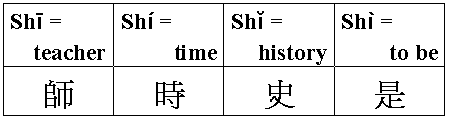
N.B. Click on the picture to get some sound with it.
Due to the difficulty of web pages to display accents above letters, I will adopt a slightly different system here: to indicate a first tone I will put a "1" behind the syllable, second tone will become "2", etc.....while an unstressed syllable will be indicated by "5."
So here an example of characters with the sound "shi", forming words:
 lao3-shi1 = litt. "old master", a common word for teacher.
 shi2-jian1 = two times the word time, thus meaning time span.
 shi3-qian2= qian means before; before history is prehistoric.
 shi4 = to be, many verbs are one character only.


